
10 Sectional Couch Pillows Styling Ideas
A sectional couch can instantly make a living room feel comfortable and inviting, but styling all that seating space with pillows can be surprisingly tricky. Too few pillows can make a large sectional look unfinished, while too many can leave the sofa feeling crowded and impractical.
The best pillow arrangement creates a balance between comfort, texture, color, and everyday usability. A sectional gives you more room to experiment than a standard sofa, so you can layer different pillow sizes, introduce a few patterns, and create separate cozy zones without making the entire arrangement look chaotic.
In my experience, the most successful sectional styling starts with the shape of the sofa. A large L-shaped sectional can benefit from pillows distributed across both sides and the corner, while a U-shaped sectional often looks better with a more symmetrical approach. The depth of the cushions also matters. Deep sectionals can handle oversized pillows and substantial lumbar cushions, whereas a shallower sofa may need smaller accents.
Color is another easy way to create cohesion. You don’t need every pillow to match. Instead, choose two or three colors that already appear in the room and repeat them through different fabrics and patterns. Cream, beige, taupe, sage, camel, charcoal, and muted terracotta are particularly versatile for modern cozy interiors.
Texture can make an even bigger difference. Linen, boucle, cotton, velvet, chenille, chunky knits, and woven fabrics give a sectional visual depth without requiring bold colors.
Whether your sectional is in a spacious family room, a compact apartment, or an open-concept living area, these styling ideas can help you create a sofa that looks polished while remaining genuinely comfortable.
Table of Contents
1. Layered Neutral Mix
Combine warm neutrals and varied textures for an effortlessly cozy sectional.
2. Oversized Corner Pillows
Use generous cushions to soften the sectional corner and create a comfortable focal point.
3. Balanced Sectional Styling
Distribute pillows evenly across the sofa for a polished, organized appearance.
4. Cozy Texture Layers
Mix boucle, linen, cotton, and knit fabrics for a tactile and inviting arrangement.
5. Earthy Color Accents
Add muted earthy tones to bring warmth and personality to a neutral sectional.
6. Lumbar Pillow Focus
Use elongated lumbar pillows to create a modern, relaxed silhouette.
7. Patterned Pillow Pairing
Combine subtle stripes, organic patterns, and solids without overwhelming the room.
8. Monochromatic Layers
Create a sophisticated sectional arrangement using different shades of one color.
9. Family-Friendly Styling
Choose practical, comfortable pillows designed for everyday living.
10. Collected Cozy Arrangement
Mix colors, shapes, patterns, and textures for a relaxed lived-in sectional.
1. Layered Neutral Mix
Quick Benefits
- Creates a timeless appearance
- Works with almost any sectional color
- Adds texture without visual clutter
- Easy to update seasonally
- Makes large sofas feel warmer
Why It Works
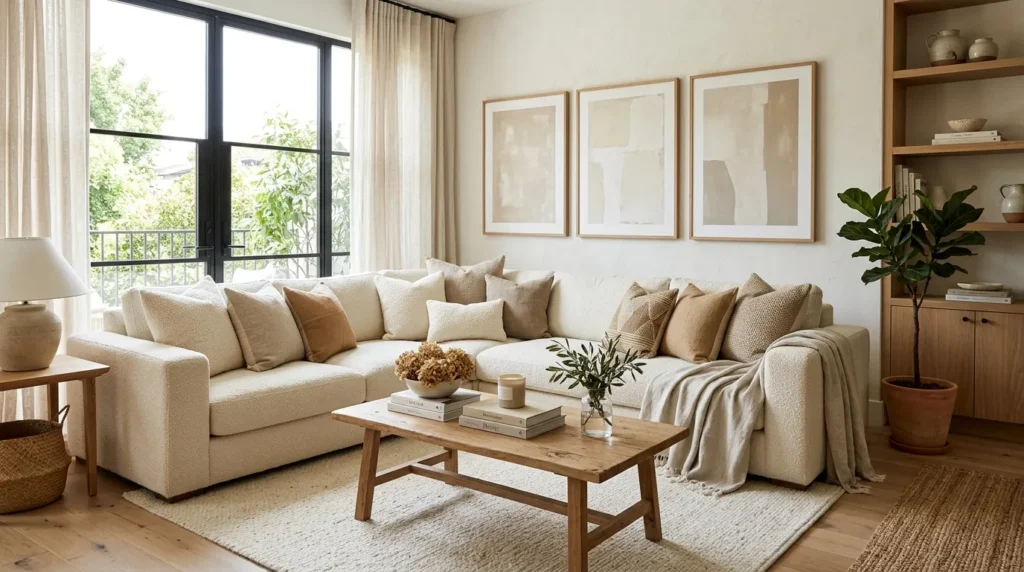
Neutral pillows are especially effective on sectionals because the large amount of upholstery can otherwise dominate the room. Cream, beige, oatmeal, taupe, and warm gray soften the scale of the sofa while maintaining a calm modern aesthetic.
The secret isn’t using identical neutral pillows. Instead, layer different tones and textures so the arrangement has depth.
A boucle pillow beside a linen cushion looks much more interesting than two identical cotton covers. Likewise, a warm camel accent can give an otherwise pale arrangement enough contrast to feel intentional.
This approach works particularly well with gray, beige, cream, brown, and charcoal sectionals. It also gives you a flexible foundation that can easily accommodate seasonal accents later.
How To Style It
Start with larger square pillows at the back corners of the sectional.
Use ivory, oatmeal, or warm beige as your foundation.
Add medium-sized taupe or camel pillows in front, then finish with one or two smaller textured lumbar cushions.
For an L-shaped sectional, place the largest pillows toward each end and use the corner as a softer transition zone.
Mix linen, boucle, cotton, and woven covers.
Keep the overall palette within three or four closely related neutrals.
2. Oversized Corner Pillows
Quick Benefits
- Makes the corner feel inviting
- Works well with deep sectionals
- Adds visual softness
- Creates a cozy lounging zone
- Reduces the need for excessive small pillows
Why It Works
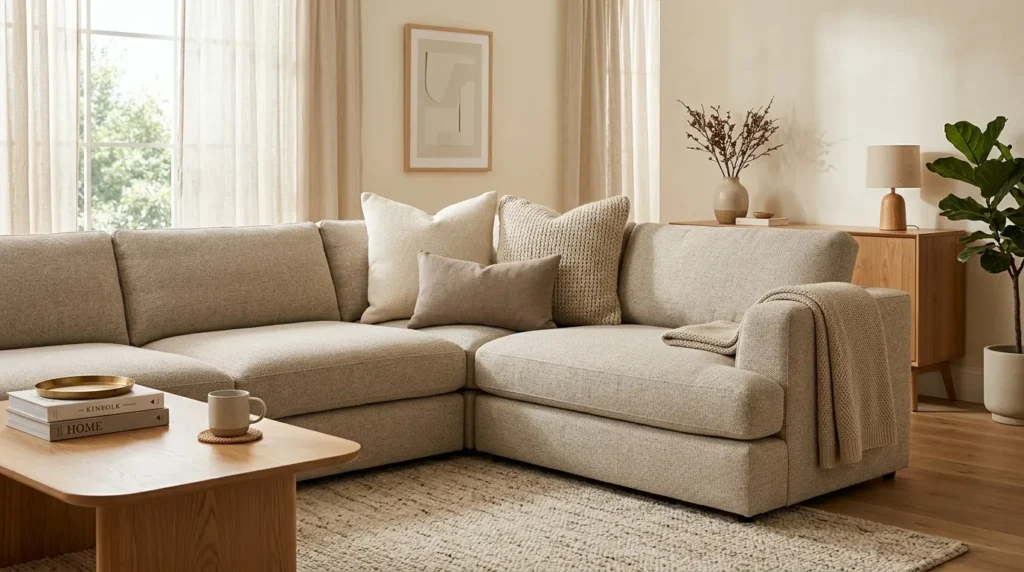
The corner of an L-shaped sectional can sometimes look empty or awkward because it has a large amount of upholstery without a clear visual focal point.
Oversized pillows solve that problem by giving the corner more presence. Large square cushions or substantial lumbar pillows can create a comfortable nest while making the sectional appear intentionally styled.
This is especially useful for deep sectionals where standard decorative pillows can look undersized.
The key is proportion. A large sofa needs pillows that are substantial enough to hold their own visually.
How To Style It
Place two oversized square pillows near the corner where the two sections meet.
Choose a textured material such as boucle, chenille, linen, or heavy cotton.
Add one smaller lumbar pillow in front.
Keep the colors relatively simple so the size becomes the main feature.
If your sectional is dark, ivory or oatmeal pillows can brighten the corner.
For a light sectional, try camel, taupe, olive, or warm gray.
Leave enough seating space around the corner so the arrangement remains practical.
3. Balanced Sectional Styling
Quick Benefits
- Creates visual order
- Works well in open-concept rooms
- Makes large sectionals feel intentional
- Prevents one side from looking overcrowded
- Easy to maintain
Why It Works
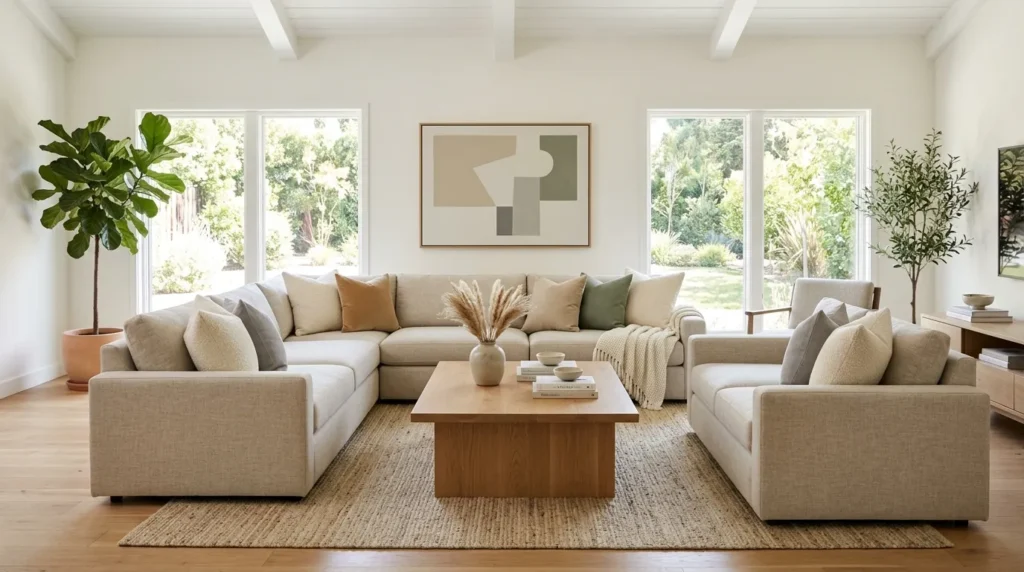
Because sectionals are large, pillow placement can easily become visually unbalanced. You may end up with one side overflowing with cushions while the other looks almost empty.
Balanced styling doesn’t necessarily mean perfectly symmetrical styling. It simply means the visual weight is distributed across the sofa.
Think about each seating section as its own zone. The corner can carry a larger grouping, while the outer ends can have fewer but larger pillows.
This approach creates rhythm and keeps the entire sectional connected.
How To Style It
Start by placing one or two large pillows at each outer end.
Add medium pillows toward the center.
Use the corner as the main layered zone.
Repeat at least one pillow color or texture across different sections.
For example, use cream boucle on both ends and add sage or camel accents toward the center.
Avoid placing every pillow in one large pile.
Step back and look at the sectional from across the room. If one side visually feels much heavier, redistribute a few pillows.
4. Cozy Texture Layers
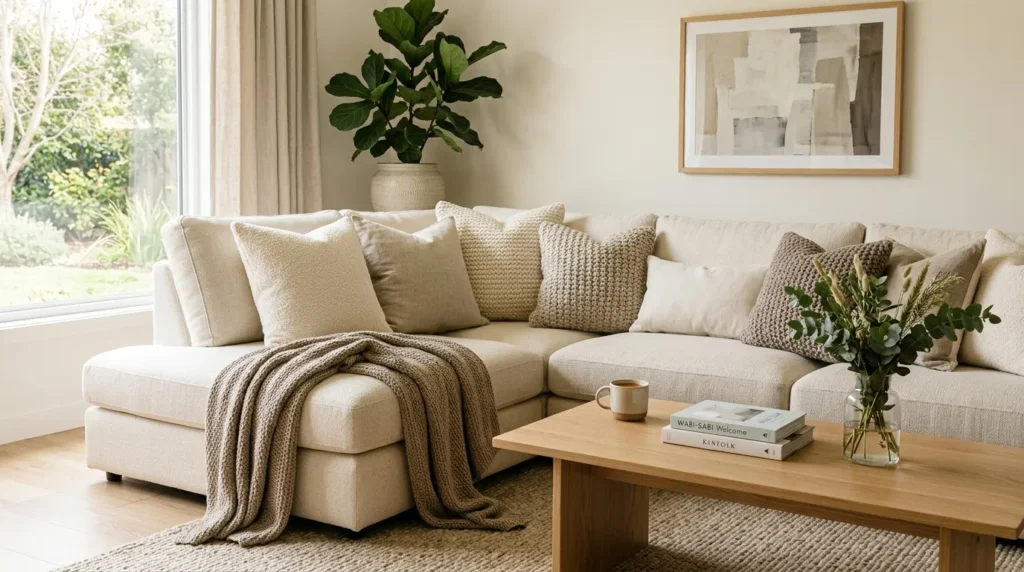
Quick Benefits
- Adds visual depth
- Makes the room feel warmer
- Works with neutral colors
- Creates a tactile appearance
- Complements modern furniture
Why It Works
Texture can make a neutral sectional look far more interesting without introducing strong colors.
A smooth sofa paired with boucle, woven cotton, linen, velvet, and knit pillows creates contrast that can be seen and felt.
This is particularly useful in modern rooms where furniture and walls may have simple silhouettes. Textured pillows prevent the space from looking overly flat while preserving a clean aesthetic.
The most successful combinations usually mix textures rather than repeating the same fabric.
How To Style It
Choose two or three dominant textures.
For example, combine cream boucle, oatmeal linen, and a chunky woven pillow.
Add one smooth cotton or velvet accent for contrast.
Keep the colors connected so the texture remains the primary visual feature.
On a large sectional, repeat the same texture in more than one location.
For example, use boucle at both ends and a woven lumbar near the corner.
Finish with a soft throw blanket draped casually over one section.
5. Earthy Color Accents
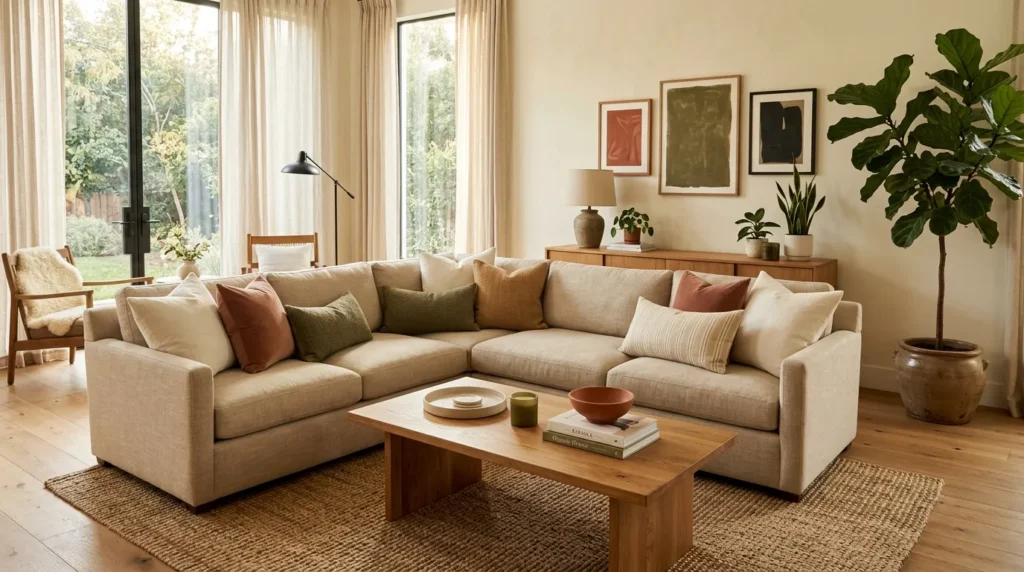
Quick Benefits
- Adds warmth
- Complements wood furniture
- Works with neutral sectionals
- Creates an organic feeling
- Makes the room feel more personal
Why It Works
Earthy accent colors can bring warmth to a sectional without overpowering the rest of the room.
Muted terracotta, olive, camel, clay, rust, sand, and warm brown are especially effective because they pair naturally with cream and beige upholstery.
The easiest way to make these colors feel intentional is to repeat them elsewhere in the room.
If your rug contains a touch of rust, use a rust pillow. If your room has olive plants, a muted sage cushion can reinforce that connection.
This creates a cohesive room rather than a sofa that looks decorated separately from the rest of the space.
How To Style It
Begin with neutral pillows in cream, beige, or oatmeal.
Choose one dominant earthy accent color.
Add one or two pillows in that shade using different textures.
For example, pair a terracotta linen pillow with a camel woven cushion and neutral boucle.
Repeat the accent color in artwork, a rug, a throw, or decorative objects.
Avoid introducing too many saturated colors.
For a modern organic look, muted colors generally work better than bright versions.
6. Lumbar Pillow Focus
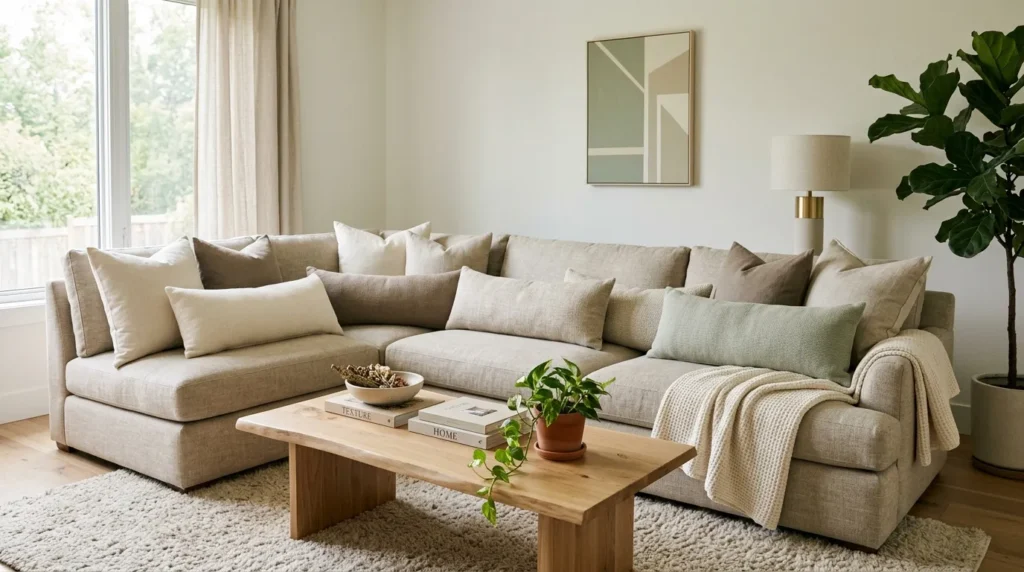
Quick Benefits
- Creates a relaxed look
- Provides practical back support
- Works beautifully on deep sectionals
- Adds horizontal contrast
- Reduces visual clutter
Why It Works
Long lumbar pillows are an excellent alternative to filling a sectional with dozens of square cushions.
Their elongated shape complements the horizontal lines of a sectional and creates a more relaxed appearance.
They can also be more practical for everyday seating because they provide comfortable support without taking up as much visual space.
A large lumbar pillow can act as the final layer in an arrangement, bringing several colors and textures together.
How To Style It
Place two larger square pillows toward the back.
Add one oversized lumbar pillow in front.
Choose a subtle stripe, woven texture, or solid color for the lumbar.
For a beige sectional, try oatmeal, camel, or muted olive.
For a gray sectional, consider cream, charcoal, stone, or soft sage.
On a large sectional, use two or three lumbar pillows spaced across the seating area rather than putting them all together.
Choose removable, washable covers when possible for everyday practicality.
7. Patterned Pillow Pairing
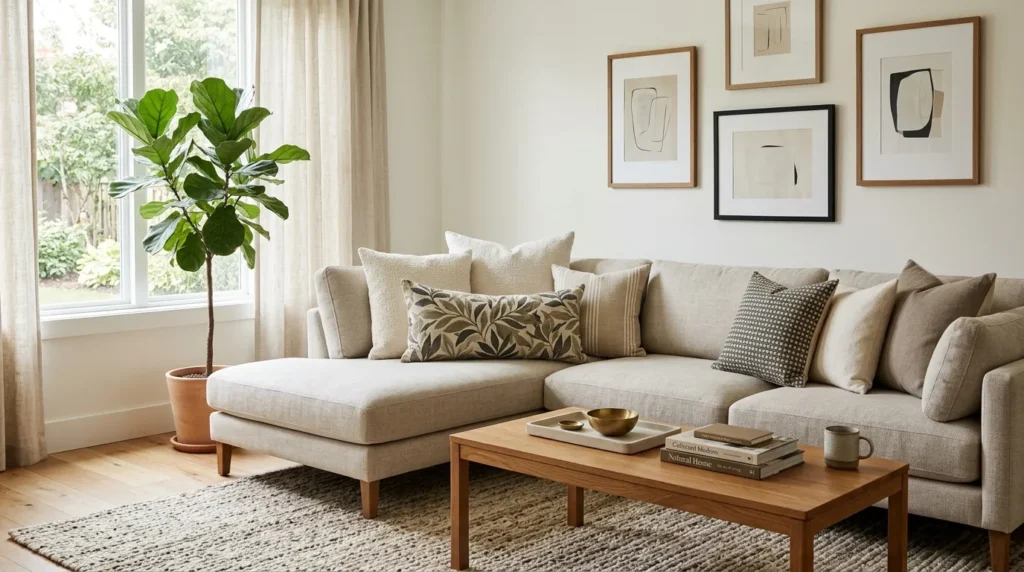
Quick Benefits
- Adds personality
- Creates visual interest
- Prevents neutral rooms from feeling flat
- Works with solid pillows
- Allows creative styling
Why It Works
Patterns can make a sectional look more finished, but using too many competing patterns can quickly create visual noise.
A simple rule is to vary the scale. Choose one larger pattern, one smaller pattern, and several solids.
For example, a subtle botanical pillow can pair with a thin stripe and solid cream cushions. The patterns don’t need to match perfectly; they simply need to share a compatible palette.
This creates the collected look Pinterest readers often love without sacrificing the calm feeling of a modern living room.
How To Style It
Choose one patterned pillow as your main focal point.
Add a smaller geometric, striped, or botanical pattern.
Surround them with solid pillows in colors pulled from the patterns.
Use neutral backgrounds whenever possible.
Keep the patterns separated rather than stacking every patterned cushion together.
If your sectional or rug is already patterned, simplify the pillow arrangement and use only one subtle accent print.
8. Monochromatic Layers
Quick Benefits
- Looks sophisticated
- Creates visual calm
- Works beautifully in modern homes
- Makes texture more noticeable
- Easy to coordinate
Why It Works
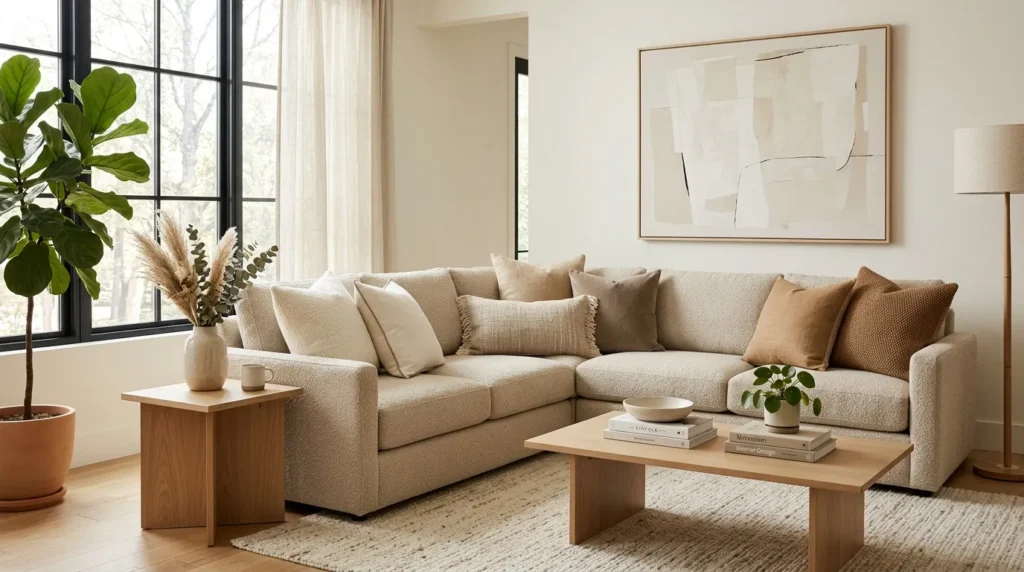
A monochromatic arrangement doesn’t mean every pillow has to be exactly the same color. Instead, it uses several shades within one color family.
This approach is ideal if you prefer a clean, sophisticated living room.
For example, a cream sectional can be styled with ivory, oatmeal, beige, taupe, and camel pillows. A gray sectional could use pearl, stone, medium gray, charcoal, and black.
The restrained palette allows shape and texture to provide visual interest.
How To Style It
Choose one main color family from the room.
Create contrast using light, medium, and dark shades.
Mix fabric textures such as linen, boucle, velvet, cotton, and woven materials.
Use larger pillows toward the back and smaller cushions toward the front.
Keep patterns subtle.
For a particularly polished look, repeat one texture at opposite ends of the sectional.
This creates continuity without requiring perfect symmetry.
9. Family-Friendly Styling
Quick Benefits
- Practical for everyday life
- Easy to maintain
- Comfortable for lounging
- Works for busy households
- Still looks polished
Why It Works
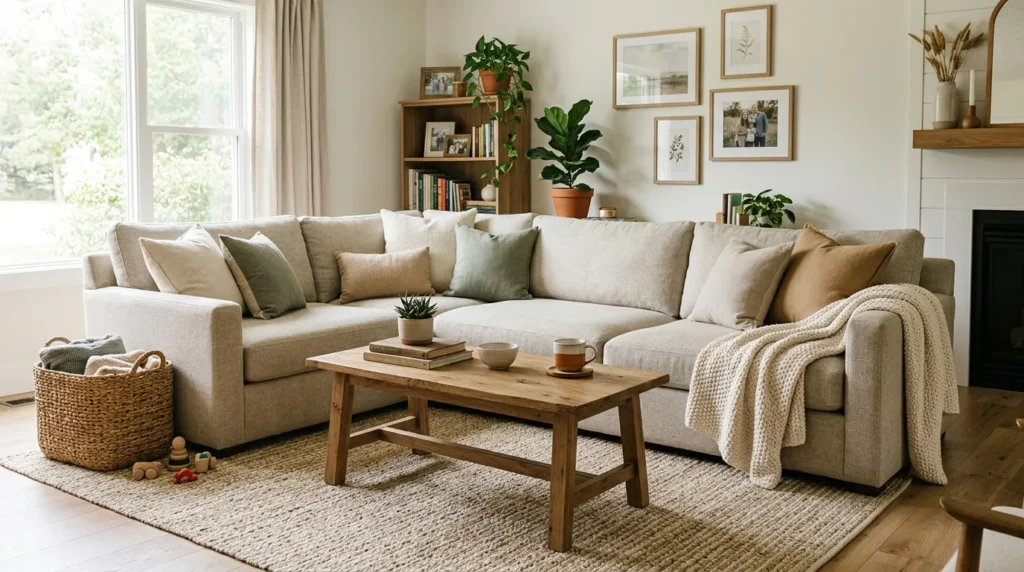
A beautifully styled sectional should still function as a real sofa. If your living room is used every day by children, pets, guests, or the entire family, delicate decorative pillows may quickly become frustrating.
The solution is to choose attractive fabrics that can handle regular use.
Washable covers, durable cotton blends, performance fabrics, and removable inserts make maintenance much easier.
You can still create a stylish arrangement while prioritizing comfort and practicality.
How To Style It
Choose pillow covers that can be removed and washed.
Avoid putting delicate embellishments on the pillows that receive the most use.
Use a few larger cushions rather than an excessive number of small decorative pieces.
Place the most durable pillows in the areas where people sit most often.
Reserve more decorative velvet, boucle, or delicate woven cushions for corners or occasional seating.
Add a washable throw blanket for extra comfort.
Keep a small basket nearby for pillows when the sectional needs to be cleared.
10. Collected Cozy Arrangement
Quick Benefits
- Feels relaxed and personal
- Works with many decorating styles
- Allows mixed textures
- Creates a lived-in atmosphere
- Easy to customize
Why It Works
The most inviting sectionals often don’t look perfectly styled. They look like someone actually lives there.
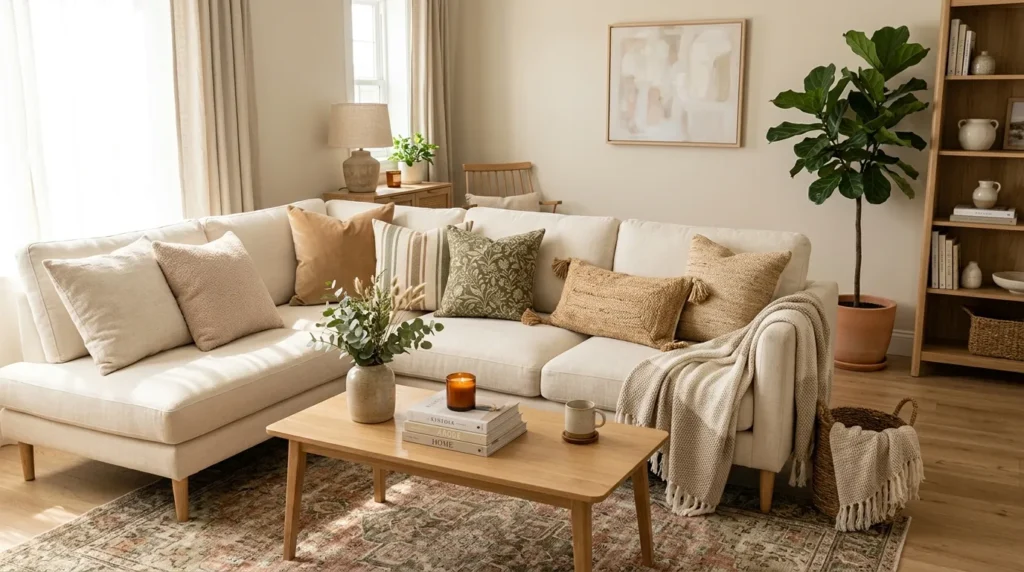
A collected arrangement can combine neutral solids, earthy accents, subtle patterns, woven textures, and different pillow shapes.
The secret is giving the mix a common thread. Perhaps all the colors are warm, all the patterns are subtle, or the fabrics have a natural appearance.
This approach works particularly well for organic modern, transitional, farmhouse, and relaxed contemporary homes.
A little asymmetry also helps. Identical pillow arrangements on both sides can feel formal, while slightly different groupings often feel more natural.
How To Style It
Begin with two large neutral pillows on each end.
Add a textured pillow to one side and a patterned pillow to the other.
Use one or two lumbar pillows to connect the arrangement.
Repeat colors across the sectional without making each side identical.
Try cream, beige, camel, olive, muted rust, and warm gray for a relaxed palette.
Finish with a casually draped throw.
Then remove one pillow if the arrangement feels crowded. A comfortable sectional should invite people to sit down, not make them wonder where to put the cushions.
FAQ
How many pillows should I put on a sectional couch?
The right number depends on the size and depth of your sectional. A medium L-shaped sectional may look balanced with five to seven pillows, while a large sectional can comfortably hold more. However, you should always leave enough open seating space for everyday use. Start with fewer pillows and add only what the sofa visually needs.
How do you arrange pillows on an L-shaped sectional?
Place larger pillows toward the outer ends and create a layered grouping near the corner. Medium pillows can transition toward the center. You don’t need to make both sides identical. Instead, repeat colors and textures throughout the sectional so the entire arrangement feels connected.
What size pillows look best on a sectional?
Larger 22- to 24-inch square pillows often work well on deep sectionals because they have enough visual scale. Medium 20-inch pillows and lumbar cushions can be layered in front. The best size depends on the depth and height of your sofa, so avoid using tiny pillows that disappear against oversized cushions.
Should sectional pillows match?
They don’t need to match exactly. Coordinating colors, textures, or patterns usually creates a more interesting result. Choose a consistent palette and repeat a few elements throughout the arrangement. This gives you variety while keeping the sectional visually cohesive.
How do I make a sectional look cozy but not cluttered?
Start with a small number of larger pillows rather than many small cushions. Use texture instead of excessive pattern to create visual interest. Keep the colors within a limited palette and leave some seating areas open. If the sectional starts looking crowded, remove one or two pillows.
What pillow colors work with a gray sectional?
Gray sectionals pair well with cream, ivory, beige, taupe, camel, sage, olive, muted blue, charcoal, and soft terracotta. Warm colors can make cool gray upholstery feel more inviting, while cream and beige create a softer neutral appearance. Choose colors that repeat elsewhere in the room for a cohesive design.
How can I style a sectional for a modern living room?
Use clean pillow shapes, restrained colors, and a mixture of tactile fabrics. Boucle, linen, cotton, velvet, and woven materials can add depth without making the arrangement overly decorative. Keep patterns subtle and use larger pillows with a few lumbar accents to maintain a streamlined appearance.
Conclusion
A sectional gives you plenty of room to create a comfortable and beautiful pillow arrangement, but the key is resisting the temptation to fill every inch.
Start with the proportions of your sofa. Deep sectionals can handle oversized cushions, while smaller sectionals may look better with a simpler arrangement. Build from larger foundation pillows, then layer smaller cushions, textured pieces, and lumbar pillows toward the front.
For a calm modern look, stay with warm neutrals and varied textures. If you want more personality, introduce earthy shades such as sage, camel, terracotta, or olive. Subtle stripes and organic patterns can add interest without making the room feel busy.
Don’t forget practicality. Your sectional is probably one of the most-used pieces of furniture in the home, so washable covers, durable fabrics, and comfortable inserts can make a major difference.
And don’t feel pressured to create perfect symmetry. A slightly relaxed arrangement often feels more welcoming and natural.
The goal is simple: create a sectional that looks beautiful in a photo but feels even better when you actually sit down.
Choose a cohesive palette, mix a few textures, distribute the pillows thoughtfully, and leave enough room for everyday life. With just a handful of well-selected cushions, your sectional can become the cozy centerpiece of the entire living room.