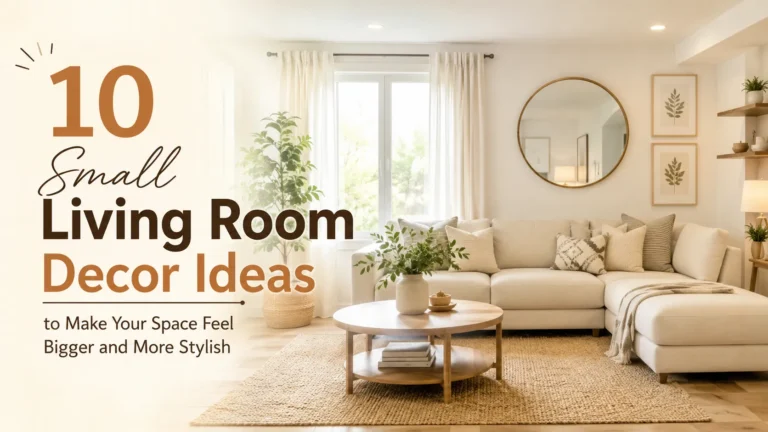
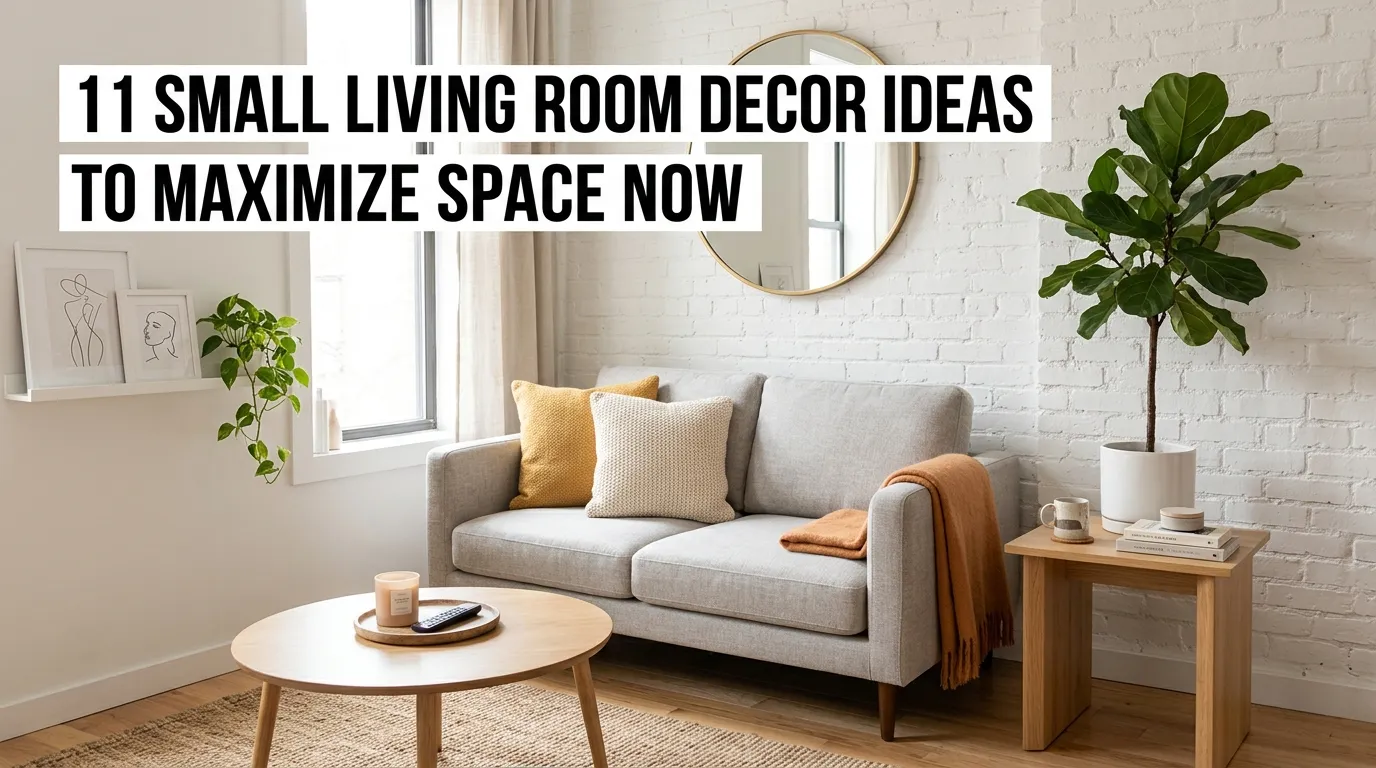
11 Small Living Room Decor Ideas to Maximize Space Now
A small living room can be one of the most rewarding spaces to decorate. When every square foot matters, thoughtful choices can make the room feel more comfortable, functional, and visually open without sacrificing personality.
The challenge is that small rooms often have to do a lot. They may need to accommodate a sofa, coffee table, television, storage, lighting, books, plants, and everyday belongings while still leaving enough room to walk around comfortably. Choose pieces that are too large, and the room can quickly feel cramped. Choose everything too small, and the space may look scattered rather than spacious.
The good news is that making a compact living room work isn’t about removing everything you love. It’s about being intentional with scale, placement, color, storage, and visual weight.
In my experience, one of the biggest improvements often comes from simply changing the furniture arrangement. A sofa positioned correctly, a rug that connects the seating area, or a coffee table with a lighter silhouette can make a surprisingly noticeable difference.
The ideas below focus on practical decorating solutions that work for apartments, smaller homes, condos, and compact family rooms. You’ll find ways to use vertical space, choose furniture more strategically, create hidden storage, brighten dark corners, and make the room feel finished without overcrowding it.
Whether you’re starting from scratch or trying to improve a room you already have, these ideas can help you create a small living room that feels intentional, comfortable, and surprisingly spacious.
Table of Contents
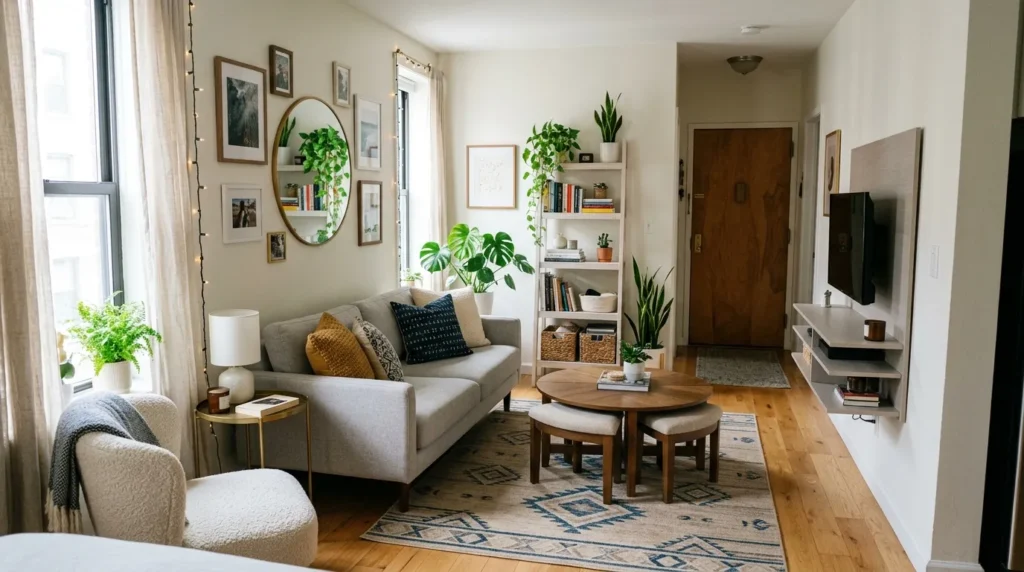
1. Light Color Palette
Use soft, reflective colors to create an airy visual foundation.
2. Compact Sofa
Choose seating that provides comfort without overwhelming the room.
3. Leggy Furniture
Use furniture with exposed legs to maintain a lighter visual footprint.
4. Floating Storage
Move storage upward and off the floor to preserve valuable walking space.
5. Large Area Rug
Use one appropriately scaled rug to visually connect the seating arrangement.
6. Round Coffee Table
Replace hard rectangular edges with a curved table that improves circulation.
7. Wall Mounted TV
Free up floor space by moving the television and media equipment onto the wall.
8. Vertical Shelving
Use wall height to create storage and display opportunities.
9. Hidden Storage
Choose attractive furniture that conceals everyday clutter.
10. Strategic Mirrors
Use reflective surfaces to brighten and visually expand the room.
11. Flexible Layout
Create an arrangement that supports both daily living and entertaining.
1. Light Color Palette
Quick Benefits
- Makes the room feel brighter
- Creates a visually open atmosphere
- Works with many decorating styles
- Helps natural light travel through the space
- Provides a calm foundation for accents
Why It Works
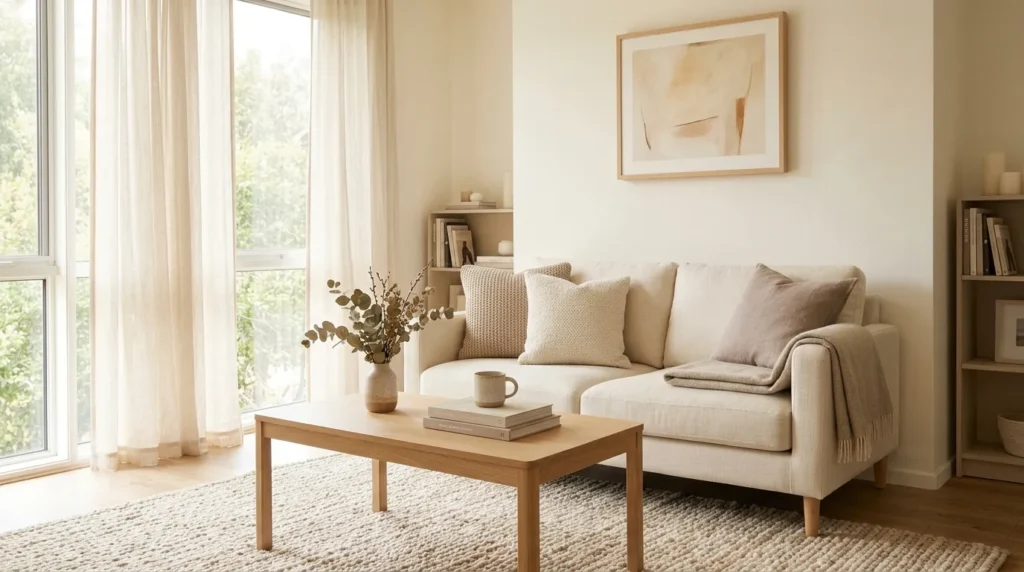
Color has a powerful effect on how we perceive a small room. Light shades can make walls feel less visually heavy and help natural and artificial light move around the space.
Warm white, cream, ivory, pale beige, soft greige, and light taupe are particularly versatile because they don’t have to feel stark. They can create a cozy room while maintaining an airy appearance.
You don’t need to make everything white. In fact, an entirely white room can sometimes feel flat. Adding subtle variations in tone through upholstery, flooring, curtains, and accessories creates depth.
The goal is visual continuity. When large surfaces share related tones, there are fewer abrupt transitions competing for attention.
How To Style It
Start with a light neutral for the walls and larger furniture pieces. A cream or soft beige sofa can visually blend into the room instead of becoming a large dark block.
Add slightly darker tones through the rug, coffee table, artwork, and cushions.
Natural wood works beautifully with light palettes because it adds warmth without creating heavy contrast.
If you love darker colors, use them in smaller doses. A charcoal lamp, black picture frame, or deep brown accent chair can provide definition without making the entire room feel visually dense.
Keep window treatments relatively light and simple so they don’t interrupt the flow of natural light.
2. Compact Sofa
Quick Benefits
- Saves valuable floor space
- Keeps the seating area comfortable
- Creates more room for circulation
- Works well in apartments
- Makes furniture proportions easier to manage
Why It Works
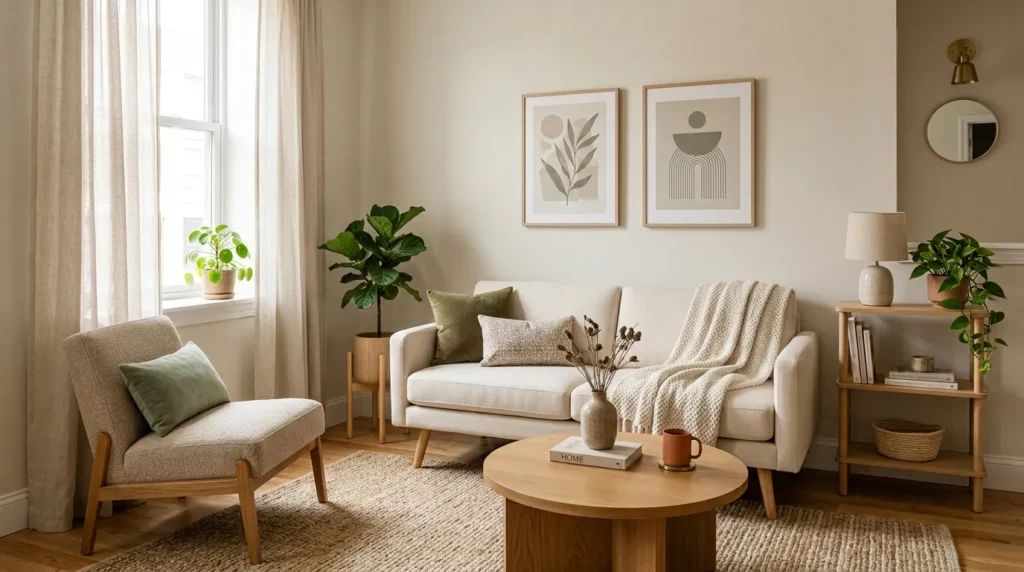
The sofa is usually the largest piece of furniture in a living room, so its scale can determine how spacious the entire room feels.
A compact sofa doesn’t mean an uncomfortable sofa. Look for designs with a streamlined profile, moderate depth, and proportions that fit the wall without extending too far into the room.
Avoid choosing a sofa solely because it looks impressive in a large showroom. A deep sectional that overwhelms your floor plan can make a small room much harder to use.
One mistake many homeowners make is measuring only the width of a sofa. Depth matters just as much because a few extra inches can significantly affect walking space.
How To Style It
Measure the wall, doorways, pathways, and surrounding furniture before purchasing.
A streamlined sofa with raised legs can create a lighter appearance than a bulky low-profile design.
If you need additional seating, consider a small accent chair, ottoman, or pouf rather than automatically choosing a large sectional.
A neutral sofa gives you more flexibility to introduce personality through pillows, throws, artwork, and rugs.
Keep enough space around the sofa for comfortable movement. Even a beautifully decorated room won’t feel spacious if the main walkway is blocked.
3. Leggy Furniture
Quick Benefits
- Makes the floor more visible
- Creates a lighter appearance
- Allows light to travel underneath furniture
- Works well with modern interiors
- Helps prevent visual heaviness
Why It Works
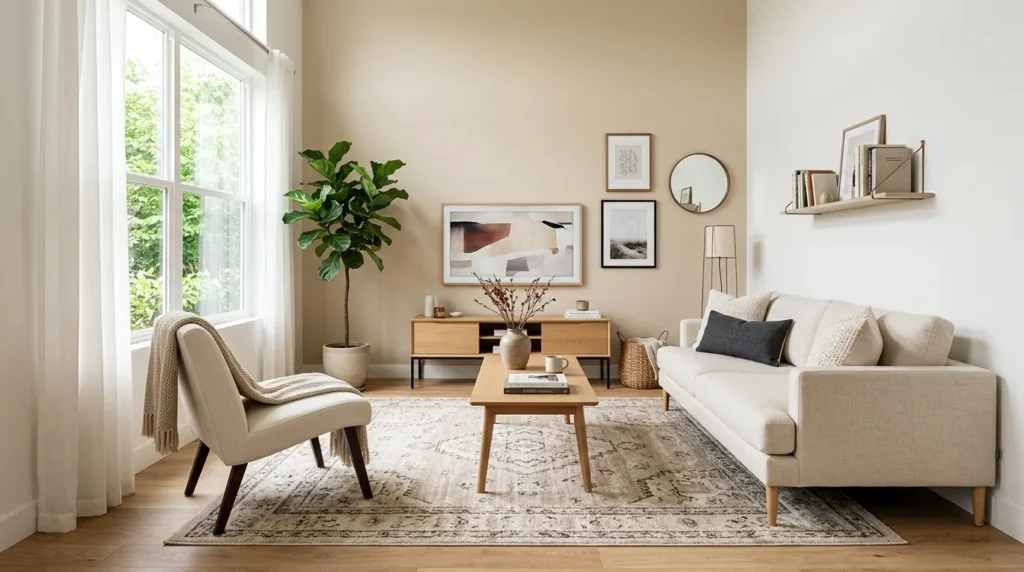
Furniture with exposed legs can create an optical sense of openness because more of the floor remains visible.
Compare a large solid cabinet that reaches almost to the floor with a console raised on slim legs. The second option generally feels less visually heavy, even if both pieces occupy similar floor space.
This is especially useful in small rooms where every visual detail matters.
Mid-century modern, Scandinavian, contemporary, and minimalist furniture often works particularly well because these styles naturally incorporate raised silhouettes.
How To Style It
Look for sofas, chairs, consoles, and side tables with visible legs.
Wooden legs can add warmth, while slim black or metal legs can create a more contemporary appearance.
Pair leggy furniture with a simple area rug so the floor doesn’t become visually fragmented.
Don’t make every piece extremely delicate. One substantial piece can provide grounding while lighter furniture maintains openness.
A raised media console is another useful choice because it allows the wall and flooring to remain visible beneath it.
4. Floating Storage
Quick Benefits
- Preserves floor space
- Makes cleaning easier
- Creates a streamlined appearance
- Uses otherwise overlooked wall space
- Works well in very small rooms
Why It Works
When floor space is limited, walls become valuable real estate.
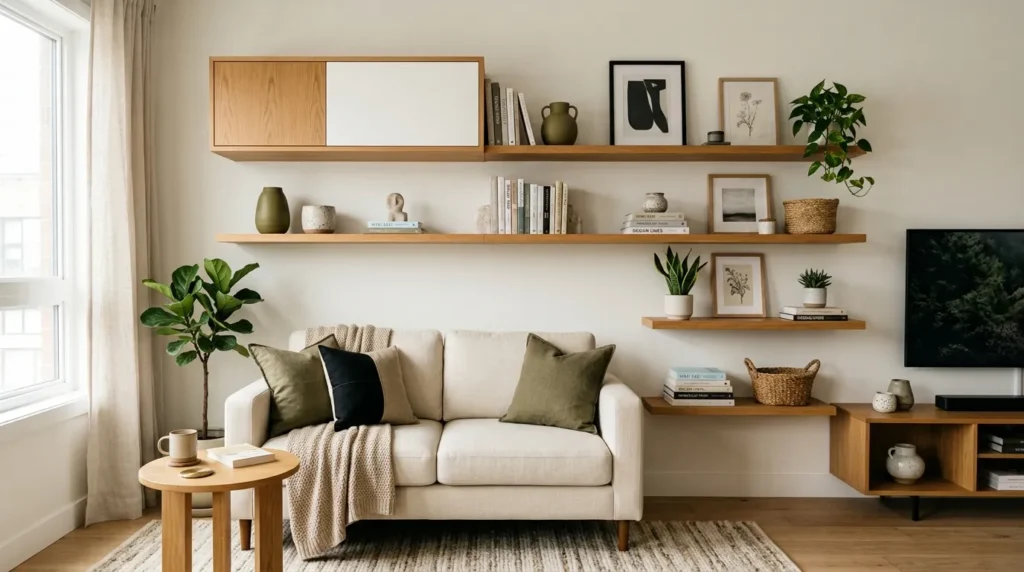
Floating shelves, wall-mounted cabinets, and slim ledges can provide storage without introducing another bulky piece of furniture.
Keeping storage off the floor also creates a cleaner visual line, which can make the room feel more organized.
This approach is particularly useful in apartments where there may be limited space for traditional bookcases or cabinets.
The important thing is not to fill every available wall. A few carefully selected storage areas can be more effective than a wall covered with shelves and objects.
How To Style It
Install floating shelves above a sofa, desk area, or media console where appropriate.
Use baskets or attractive boxes to conceal small everyday items.
Keep decorative displays edited. A few books, ceramics, plants, and framed pieces can create interest without making the shelves look crowded.
For heavier storage, use properly rated wall hardware and make sure the mounting system is appropriate for the wall construction.
A combination of closed and open storage is often ideal. Closed cabinets hide visual clutter while open shelves provide opportunities for personality.
5. Large Area Rug
Quick Benefits
- Defines the seating area
- Creates visual cohesion
- Makes furniture feel connected
- Adds warmth and texture
- Can make the room feel more intentional
Why It Works
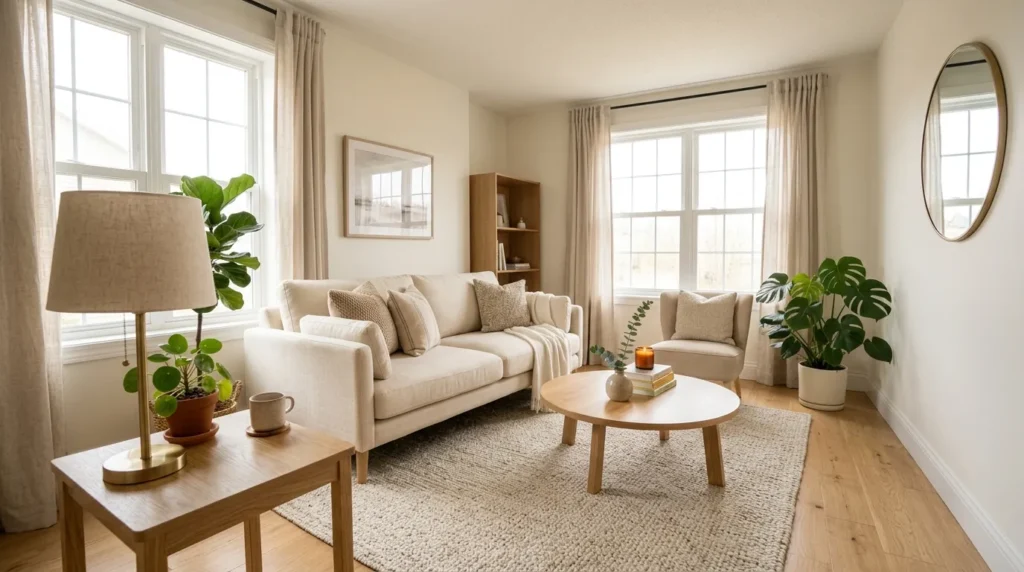
It may seem counterintuitive, but a larger rug can sometimes make a small living room feel bigger.
Several tiny rugs can divide the floor into separate visual zones, making the room appear fragmented. One appropriately scaled area rug can instead connect the main furniture pieces into one cohesive arrangement.
The rug acts almost like an invisible boundary around the seating area.
This doesn’t mean covering the entire floor. Leave some flooring visible around the perimeter so the rug looks intentionally positioned.
How To Style It
Measure your seating arrangement before selecting a rug.
Ideally, the front legs of the sofa and chairs should sit on the rug, creating a connected grouping.
A neutral rug can keep the room calm, while a subtle geometric or vintage pattern can add personality.
Avoid a rug that is so small it appears to float beneath only the coffee table.
If you’re unsure about the size, mark the proposed dimensions with painter’s tape before purchasing. This is an easy way to see how the rug will relate to the furniture.
6. Round Coffee Table
Quick Benefits
- Improves circulation
- Removes sharp corners
- Creates visual variety
- Works well with compact seating
- Can make awkward layouts easier to navigate
Why It Works
Small living rooms often have tight pathways, and a rectangular coffee table can make those paths feel even narrower.
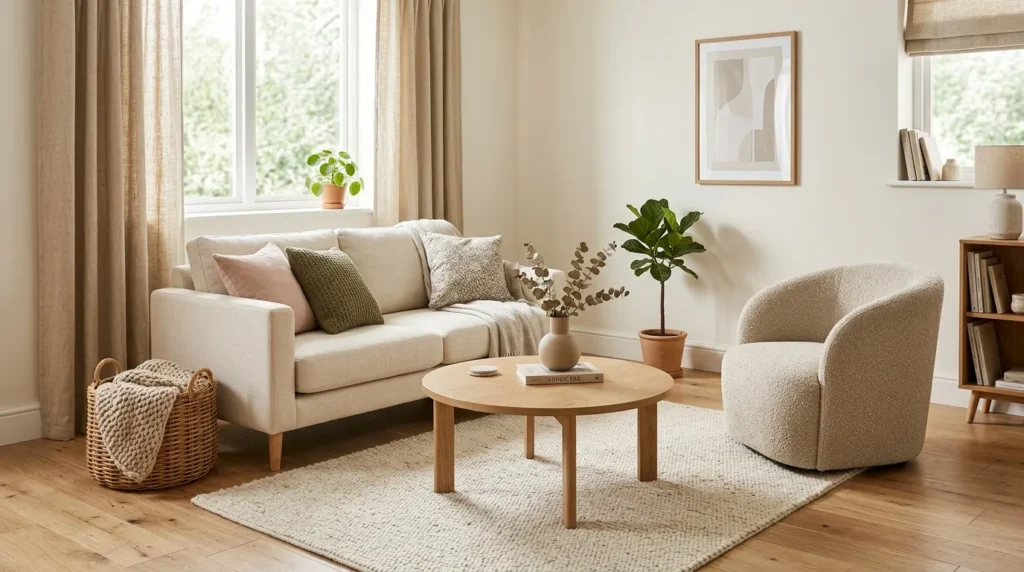
A round coffee table eliminates sharp corners and creates a smoother visual transition around the seating area.
This is particularly useful when the sofa faces a television wall or when multiple pathways meet around the center of the room.
A round table can also soften a room filled with rectangular shapes such as sofas, windows, media consoles, and rugs.
How To Style It
Choose a coffee table that is appropriately scaled to the sofa.
A round wood table works beautifully in warm, organic interiors. A glass or acrylic option can provide an even lighter visual effect in very compact rooms.
Keep the tabletop styling simple.
A small tray, ceramic vase, candle, or stack of books may be enough.
Make sure there is comfortable clearance between the table and surrounding seating so people can move around it without bumping into furniture.
7. Wall Mounted TV
Quick Benefits
- Frees floor space
- Creates a cleaner media area
- Reduces bulky furniture
- Makes small walls easier to organize
- Supports a streamlined aesthetic
Why It Works
A traditional media cabinet can consume valuable floor space in a compact room.
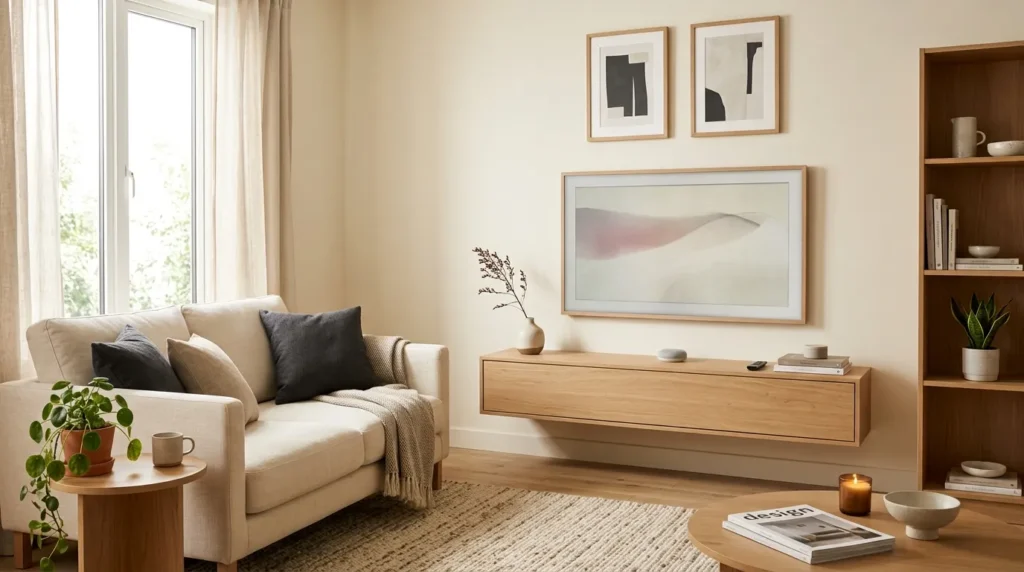
Wall-mounting the television can free that area for a slim console, storage basket, plant, or simply open floor.
The visual effect can be especially helpful when the TV wall is already a focal point.
However, the installation should be planned carefully. Consider viewing height, cable management, wall construction, and access to electrical connections before mounting anything.
How To Style It
Keep the area around the television relatively simple.
A slim floating media console can provide storage while maintaining the open floor underneath.
Hide cables as much as practical and avoid filling the wall with unnecessary accessories.
If you want to soften the technology, add a small plant, framed artwork, or a few restrained decorative objects nearby.
The goal is to create a balanced media wall rather than making the television compete with excessive decoration.
8. Vertical Shelving
Quick Benefits
- Takes advantage of wall height
- Adds useful storage
- Draws the eye upward
- Creates room for decor
- Reduces dependence on floor furniture
Why It Works
When you don’t have much floor space, look upward.
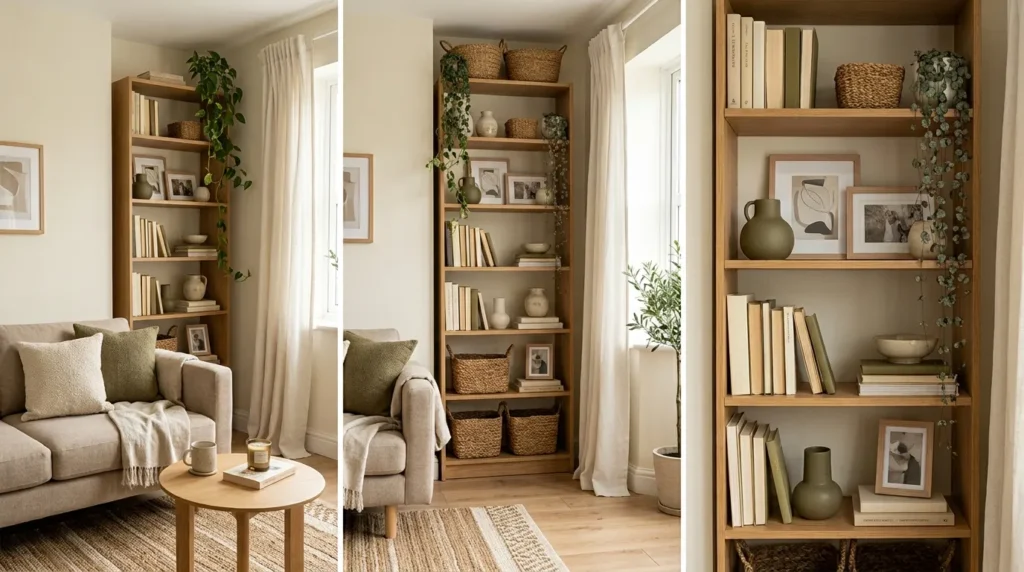
Tall shelving can provide substantially more storage than a short cabinet occupying the same footprint.
Vertical lines can also encourage the eye to travel upward, emphasizing ceiling height.
This makes tall, narrow shelving especially useful in apartments and compact living rooms.
Open shelving is attractive but requires organization. If everything is displayed, the room can quickly feel busy.
How To Style It
Choose a narrow bookcase or vertical shelving unit that fits comfortably against the wall.
Use a combination of books, baskets, plants, framed artwork, and decorative objects.
Keep some shelves partially empty.
Group objects in small collections rather than scattering individual items across every shelf.
If the shelving is tall, place heavier visual elements toward the lower portion and lighter objects toward the top.
For a particularly small room, choose a design with a slim frame rather than a deep cabinet.
9. Hidden Storage
Quick Benefits
- Reduces visible clutter
- Keeps everyday items accessible
- Creates a cleaner room
- Combines function with decoration
- Works especially well for apartments
Why It Works
Clutter can make a small room feel significantly smaller.
The solution isn’t necessarily owning fewer things. Sometimes it’s giving everyday belongings a designated place where they can be quickly stored.
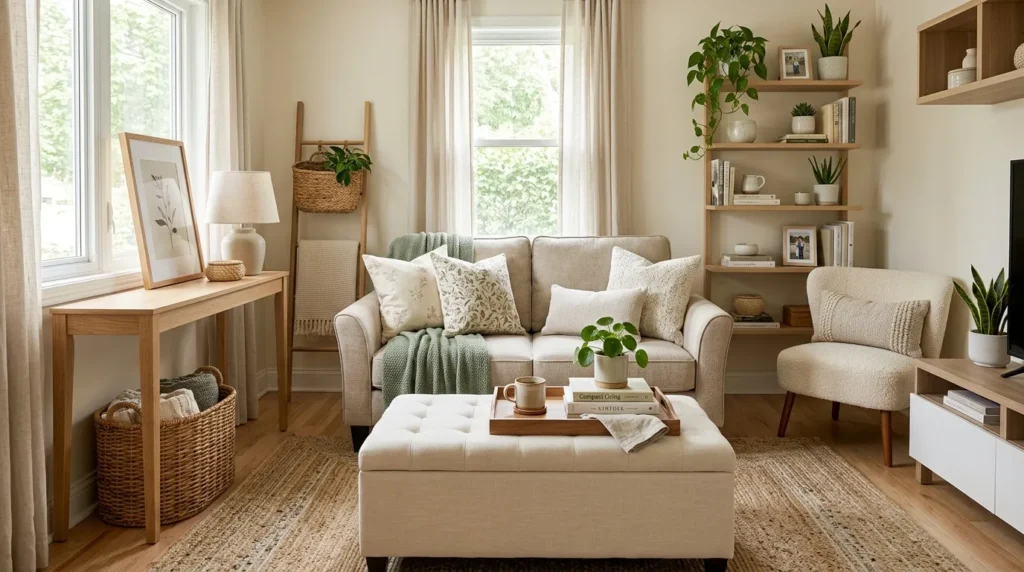
Ottomans with hidden compartments, storage benches, lift-top coffee tables, baskets, and cabinets can help keep blankets, books, remotes, toys, and other items out of sight.
When the eye sees fewer loose objects, the room generally feels calmer and more spacious.
How To Style It
Choose furniture that performs more than one job.
An upholstered storage ottoman can serve as seating, a footrest, and hidden storage.
A coffee table with drawers can hold remotes and books.
Woven baskets can hide blankets while adding texture to the room.
Keep the exterior of storage pieces visually simple. The goal is to reduce clutter rather than create another decorative focal point.
Use frequently accessed storage in the most convenient locations so maintaining the room doesn’t become a chore.
10. Strategic Mirrors
Quick Benefits
- Reflects natural light
- Adds depth
- Brightens darker areas
- Creates the impression of openness
- Provides decorative interest
Why It Works
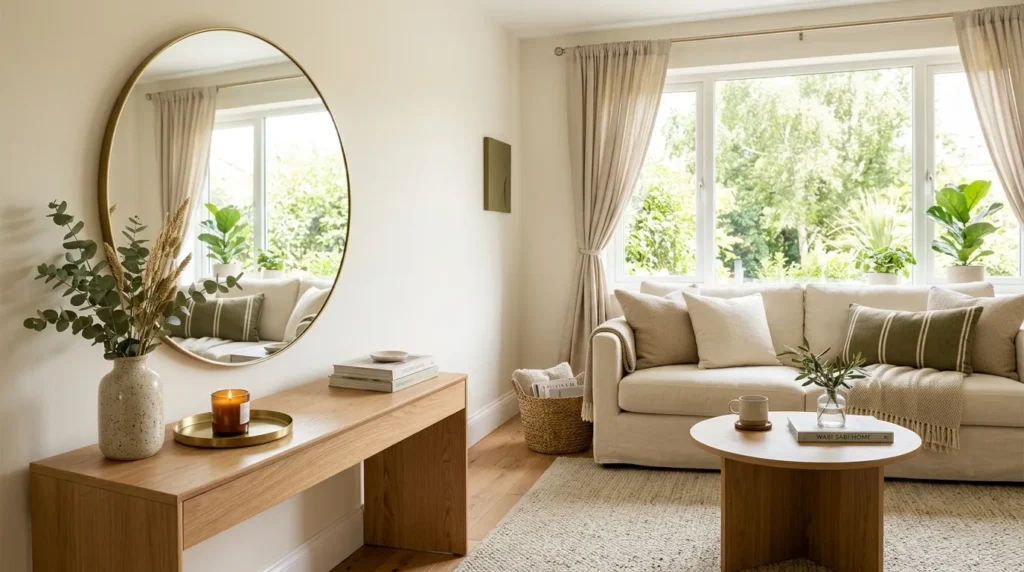
Mirrors can be especially effective in compact living rooms because they reflect light and nearby surfaces.
A well-positioned mirror can make a wall feel less solid and create the impression that the room continues beyond its physical boundaries.
Placement matters more than simply owning a large mirror.
A mirror facing a window can reflect daylight, while one positioned opposite an attractive architectural feature or artwork can effectively duplicate that visual interest.
How To Style It
Choose a mirror size that relates to the wall and furniture beneath it.
A large round mirror above a console can soften a room filled with straight lines.
A tall mirror placed near a window can reflect light and emphasize vertical space.
Keep the surrounding area relatively uncluttered so the reflection remains attractive.
Avoid positioning mirrors where they reflect an unattractive pile of clutter or a visually chaotic part of the room.
11. Flexible Layout
Quick Benefits
- Makes better use of limited floor space
- Improves everyday movement
- Supports multiple activities
- Makes entertaining easier
- Allows the room to adapt
Why It Works
The best small living rooms aren’t necessarily filled with clever furniture. They’re simply arranged around how people actually use the space.
Think about where you walk, where you sit, where you watch television, where you place drinks, and where guests naturally gather.
A flexible layout can allow the same room to work for relaxing, reading, entertaining, working, and family activities.
This is particularly important when the living room needs to serve multiple purposes.
How To Style It
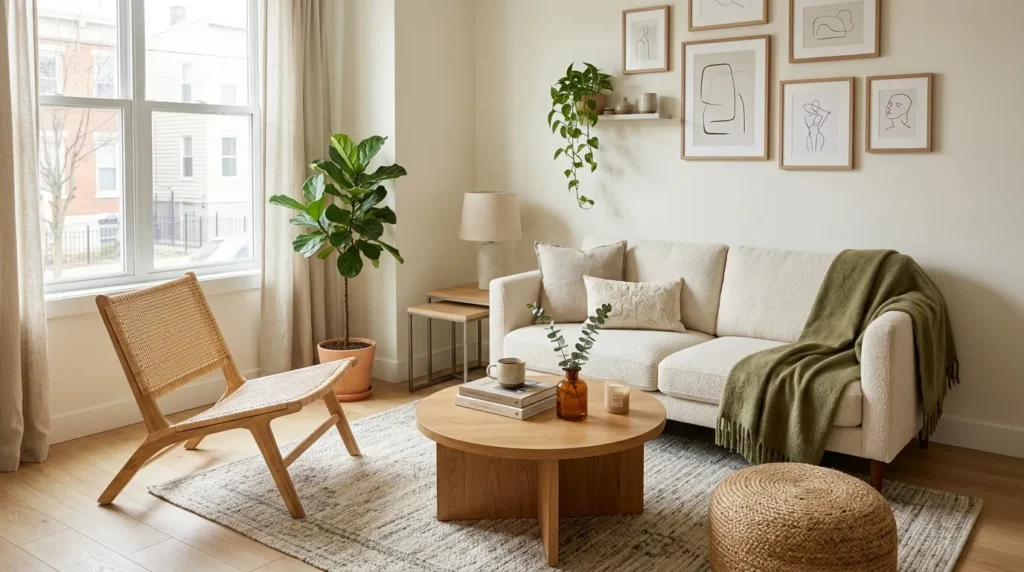
Start by identifying the room’s primary focal point, such as a television, fireplace, large window, or architectural feature.
Position the sofa to establish the main seating zone.
Then add one or two smaller flexible pieces rather than filling every remaining corner.
A lightweight accent chair can be moved when guests arrive. A pouf can act as seating or a footrest. A nesting table can expand the usable surface when needed.
Keep the main walking paths clear and avoid pushing furniture into awkward corners simply because there is empty wall space.
How To Arrange Furniture In A Small Living Room
Furniture arrangement should come before decorative accessories.
Start with the largest piece, usually the sofa. Position it in relation to the main focal point while leaving enough room for comfortable circulation.
Then add the coffee table and secondary seating.
Don’t automatically push every piece against the wall. Sometimes bringing a chair slightly inward can create a more intimate conversation area.
At the same time, avoid creating unnecessary obstacles.
A useful approach is to sketch the room from above or use painter’s tape to mark furniture dimensions on the floor.
Measure everything before buying. Remember to measure doorways, stairways, elevators, and hallways too if you’re furnishing an apartment.
The best arrangement is the one that feels natural when you walk through the room.
How To Make A Small Living Room Feel Bigger
There isn’t one decorating trick that magically adds square footage, but several small choices can work together.
Use related colors across large surfaces.
Choose furniture with an appropriate scale.
Keep pathways open.
Use one cohesive rug instead of several small floor coverings.
Take advantage of vertical storage.
Allow natural light to enter freely.
Use mirrors where they reflect something attractive.
Choose furniture with exposed legs when practical.
Most importantly, avoid unnecessary visual fragmentation. When the eye can move smoothly from one part of the room to another, the space often feels calmer and more open.
Small Living Room Storage Ideas
Storage becomes especially important when floor space is limited.
Look for furniture that performs multiple functions.
Storage ottomans can hide blankets and accessories.
Baskets can organize children’s items, throws, magazines, or electronics.
Floating shelves can hold books and decorative objects without taking floor space.
A slim console can provide a landing spot for keys and small items.
Closed cabinets are useful when you want the room to look especially clean.
Don’t underestimate the space beneath furniture either. If a sofa or cabinet has enough clearance, low-profile storage containers can sometimes make use of otherwise wasted space.
Colors That Work Best In Compact Living Rooms
Light neutrals are popular for a reason, but you don’t have to avoid color.
Cream, ivory, beige, greige, pale gray, and soft taupe create versatile foundations.
Muted sage, dusty blue, terracotta, warm brown, and soft blush can introduce personality.
If you prefer dark colors, use them strategically.
A charcoal accent chair, deep green cushions, or dark artwork can create contrast without visually shrinking every surface.
Another effective approach is using similar tones throughout the room. Tonal decorating reduces abrupt visual breaks and can make the space feel more cohesive.
Common Small Living Room Decorating Mistakes
One of the most common mistakes is buying furniture without measuring.
Another is using too many tiny decorative pieces. A collection of small objects can sometimes create more visual clutter than one substantial piece.
Choosing a rug that is too small is another frequent issue. It can make the seating arrangement look disconnected.
Don’t block natural light with bulky furniture or heavy curtains unless the room requires them.
Avoid filling every wall simply because it’s empty.
Finally, don’t prioritize appearance over comfort. A living room is meant to be used. If the furniture looks beautiful but makes everyday movement difficult, the layout needs another adjustment.
FAQ
How can I make a small living room look bigger?
Use light or cohesive colors, appropriately scaled furniture, open walking paths, one well-sized area rug, vertical storage, and strategically positioned mirrors. Keeping clutter contained also makes a significant difference. The goal is to reduce visual interruptions while allowing the eye to move naturally around the room.
What size sofa is best for a small living room?
The best sofa depends on the room’s dimensions, but compact sofas with moderate depth and streamlined arms are often easier to accommodate. Measure the available wall and surrounding pathways before shopping. Don’t forget to measure doorways and entry points to make sure the sofa can actually reach the room.
Should I use a large rug in a small living room?
Often, yes. A properly scaled larger rug can visually connect the sofa, chairs, and coffee table instead of dividing the floor into several small zones. Make sure the rug leaves an appropriate border of visible flooring and doesn’t interfere with doors or major pathways.
What furniture saves the most space?
Multifunctional furniture can be particularly useful. Storage ottomans, nesting tables, floating consoles, wall-mounted media units, compact sofas, and furniture with built-in drawers can provide multiple functions without requiring additional pieces.
Are mirrors good for small living rooms?
Yes. Mirrors can reflect natural light and create additional visual depth. Their placement matters, though. Position them where they reflect daylight, attractive architecture, greenery, or another appealing feature rather than clutter.
How do I decorate a small living room without making it cluttered?
Start with the essential furniture and add decorative elements gradually. Choose a few larger, meaningful pieces instead of many small accessories. Use closed storage for everyday clutter, keep surfaces partially empty, and leave enough negative space around furniture and decor.
Can a sectional work in a small living room?
A sectional can work if its dimensions and orientation fit the room. Measure the full length, depth, and chaise projection before buying. A compact apartment-sized sectional may be more appropriate than a large traditional sectional. Make sure the arrangement still leaves comfortable walking paths.
Conclusion
A small living room doesn’t have to feel limited. With the right combination of scale, layout, storage, color, and lighting, even a compact space can feel comfortable, organized, and stylish.
Start with the furniture arrangement before buying decorative accessories. Choose a sofa that fits the room rather than simply choosing the largest one you can squeeze inside. Use a well-proportioned rug to connect the seating area, and consider rounded furniture when circulation is tight.
Then look upward. Floating shelves, vertical bookcases, wall-mounted media units, and strategically placed mirrors can help you use the room’s walls without consuming valuable floor space.
Storage is equally important. When blankets, electronics, books, toys, and everyday items have a designated home, the room instantly becomes easier to maintain.
You don’t need to remove all personality from a compact space, either. Plants, artwork, cushions, ceramics, and carefully chosen accent pieces can make the room feel personal without overwhelming it.
The best approach is to decorate with intention. Give every major piece a purpose, protect your walking paths, and leave enough breathing room for the room to feel comfortable.
Start with one change at a time. A better furniture arrangement, a lighter rug, a wall-mounted shelf, or a storage ottoman can make a noticeable difference. With thoughtful choices, your small living room can feel much more spacious while still looking warm, inviting, and completely yours.